The day after I fly back to Vancouver Island, I go to visit my father and Sandy. I don't tell them I am coming. They have been away and have come home early after he put his back out tying lines at the dock. "We've just been reading your blog," Sandy says, as she greets me at the door with a hug. My father comes in from the living room. He's crying. I haven't seen my father cry, that I can remember, since I was 10 years old and we were spending the last night in an apartment he rented during his divorce from my mother. Suddenly, I realize, stupidly late, that people have been reading these words. That my difficulty has been their difficulty these last weeks. I've brought a guest and we spend the next four hours missing ferries and talking and talking and I feel encompassed and made of air.
The sorting out continues. I am told by people this will be a long process. I traveled back, with a stop in Toronto to hug and spend time with as many of my friends as possible, with a growing sense that what I did over in Ukraine, Poland, Lithuania, and what I saw, was both necessary and totally ludicrous. The care my friends take of me in Toronto is stupendous, exquisite. But the reality of what the Jewish archivist told me begins to sink in. I may have sung to ancestors in two graveyards in two countries, but they may not have been mine. I may have the wrong information. They may be in the next shetl over. They may be lying 100 kilometres away. There is a sense of having cast a voice out into the air, with no way of knowing how far it will carry, or what will be heard. I remember leaving the town of Berdychiv by car, taking a different route back and realizing that I would likely never return, and sobbing briefly, before I had to get it together, knowing there was no one else on this trip to make the travel arrangements for the next day, to get us back safe to Kiev, to buy dinner. I stopped crying.
Then there is the issue of what I say to those I love when I return. My father only said, "good, I'm glad you're going," when I told him I was going to Auschwitz. He said nothing of what he saw. And so what do I say? To those who have not read this, what is the protocol? I decide to follow suit, and use words like "challenging" and "intense" when people ask me how the trip was. I don't elaborate. I take back a gardening contract, turning water systems on and off and working the earth. I walk my dog and swim her in the cold winds and water of a summer that leaves the night after I arrive. I spend the first night back in the back garden and then am driven back inside, missing the heat of Europe, missing Mexico. I miss everywhere I've ever been. I feel like my feet aren't even touching the ground here, as if I've been taken under in Poland's forests or on the banks of the Neris in Vilna.
Finally, there is the idea of home. How does one come to a new land? I've now taken the same journey as my grand and great-grandparents, albeit by different type of vessel. We have both passed through a European theatre; we have both arrived to what is ultimately a foreign destination, however much I feel Saanich, in the end, however much my life centres here. In the end, the feeling I'm left with is perhaps less settled than the one my ancestors felt after 41 years in America: discombobulation, confusion, unease, mixed with total familiarity. I drink. I fiddle with my meds. I fight over issues that don't need to be fought over. I gain and lose equilibrium in the space of five minutes. I check airline ticket prices. I take jobs I don't want. I can't quite cry.
It was Gary Snyder, I think, who said the best thing we can do for the environment is to just stay home. What do you do when your home belongs to the Coast Salish First Nations, and the home of your ancestors is a giant pit of burned human ashes at the edge of a concentration camp, marked with a plaque and topped with a few pebbles that some people have thought to bring (in their suitcases, and what a strange thing, to put a pebble in a suitcase and bring it half way across the world)? My pebbles from my garden are in Berdychiv's cemetery and on the Auschwitz memorial plaques made by some artist who made something that no one understands, apparently (according to my guide) and in the Łomża cemetery. It's not enough. It will never be enough. I smile at the beyond and drink another glass of wine.
Wednesday, June 15, 2016
Wednesday, June 1, 2016
The last supper
 When I finally reached the Kiev archives after 24 hours of travel from Lisboa through Warsaw, it was an hour before closing. I had all my luggage with me. The receptionist showed me down pea-coloured hallways (walls, ceiling, floor) where various side doors were not only padlocked but had a seal of wax hanging from a string, the string melted into the seal and stamped. I was shown into an office, where two secretaries faced one another at desks and gestured me into one of the adjoining inner sanctums. That was where I met the future antagonist for the next Bond movie. Blond spiked hair, perhaps seven feet tall, glittering blue eyes and an air of not just annoyance but open hostility, before I even opened my mouth. "I'm Jewish," I began. "I'm looking for my family." It went downhill from there.
The conversation progressed from a thorough talking-to and various questions about why I was there, to why I hadn't done this or that first (which I had) and what I could possibly hope to find because all of the records except from 1857 and 1897 had been completely destroyed. Finally, the worm turned. Once it did, she relented a little, writing down an address for the regional Kiev archives. Russian women are very, very formidable.
On my way out, I chatted with the security guard who spoke three words of English. I've begun to realize, after so much time on my own in countries where I don't even read the characters of the words of a language, let alone speak it, that this kind of bubble has its advantages. "Do you always hire such loving people?" I asked him. "Does she whip you in the back room when no one else is around? I suppose archives are best if people can't access them?" He smiled. I smiled. We both thought everything was just fine. He walked me to the corner and showed me where to catch a bus, and wrote out the number. To celebrate, I hauled my bulging 48 pound suitcase up the road and let myself be swindled by another taxi driver who snap chatted his friends the whole way to the hotel.
That night, I went out to the most expensive restaurant in Kiev. Thirty dollars later I had drunk a full bottle of wine, tasted Georgian pie and eggplant and baklava and a coffee that came with its own set of cutlery. I walked back and climbed to the 12th floor and watched the city, and thought about lostness, and loneliness, and how long this trip has been, and how short, and started to feel the first strains of panic at my impending departure. I love home, but I never want to go back there.

I walked through the park, after saying goodbye. Across the road were the familiar faces in enamel on tombstones that I had seen and photographed in the cemetery of Berdychiv. The grass was long, but the stones looked tended. I turned into the memorial park, which covered many city blocks, and ended up wandering through the poplars and groves of wisteria-like trees that smelled incredible for over an hour. It was my first time walking in a forest since Poland, and it was also the site of a mass killing.

Two Russian men have lit cigars behind me, telling the server, more or less, to go to hell when she tells them there's no smoking on the patio. I think they may be planning the next Mafia insurgency. She comes and moves my table a little out of their way, out of concern for me. When they leave (without paying) she heaves a sigh of relief, and confirms my suspicions. It's 22 degrees at ten at night. I think of the white trunks of the poplars, giving out their seeds in cottony drifts, and the birches and red pines and the Israeli soldiers and the incredibly fierce and human and strange and antagonistic look in the eyes of so many I've seen in this city passing me in the streets. I've never seen so many blue eyed people. I'm far from unusual. But still they look at me strangely. As if they're seeing a vestige from the past. I remember the Polin museum in Warsaw, the history of Jewish peoples over the last 1000 years in Poland. The best museum I've seen in my life. People lived right outside the Warsaw ghetto, its interpretive text said, and they did nothing, for the most part, to help those inside.
Maybe, as Mark Strand writes, I'm still moving to keep things whole.


Sunday, May 29, 2016
Lisboa y Sevilla
A love letter for Lisbon and Sevilla.
 Friday:
As I write this in Lisbon, an old man in the tiny restaurant next to the bigger, expensive restaurant, is gesturing with a cane behind my head. He's standing in the doorway, and there is a giant mesh bag of empty snail shells strung up above him. Out on the sidewalk on a wood and metal chair, a man he may or may not be talking to (he seems to be talking to anyone in particular) sleeps. Or tries to. The sidewalk is made of cut two inch square blocks of cream marble. The street itself is darker cut stone. The lines for crosswalks are made using the cream marble, lined up in rows. Women pass. They are beautiful. Then men who the old man calls to. I am drinking my second cup of red wine. It costs one euro each glass. I've just eaten a pescado dorado, a fried fish with a body about the size of my open hand. It was plump and white and crispy on the outside, its eye socket browned and the tail and bones intact. It came with plain potatoes and a tomato and onion salad and bread and a side plate of olives. Oil and vinegar are always on the table. Across from me, a funicular sits at rest, ready for its journey up to the top of the hill where Sheila lives. The hills are so steep here, throughout the city, that you climb them using stairs, also made of marble.
We stay here for three days, eating fish and Sheila working while I roam the old Arab quarter and keep my ration of egg tarts under three per day. On my birthday, we drive to King Ferdinand's expansive forest gardens, where Portuguese broom mixes with Australian tree ferns and rhododendron forests for the opening of an in-situ art installation. In an effort to make more people explore the gardens, twenty international and Portuguese artists have been invited to create works within the grounds. One is a giant cork, the size of a small bus. Another is a cleft in the earth with the same cream marble from the city streets inserted into its depths. At night, we drive back into Lisbon and find dinner with Mario, who owns Taverna, and who feeds us salted lamb and cheese and red wine and chocolate mousse. he gives me a tea light as a birthday candle. He tells us that most of the Portuguese have some quantity of Jewish blood.
Saturday and Sunday:
 In a small single bed, with the tall doors of one of five balconies open to the night air, I go to sleep and wake up to bells from the nearby churches. The apartments opposite are five feet across the narrow pedestrian corridor. Swallows and swifts circle the rooftops and the voices of people below, coming back from tapas, echo up the alleys. It's 5am. We are just about to sleep. The apartment belongs to a Canadian/Spanish family with six children who have had it in the family for more than 100 years. The ceilings are 14 feet and the wooden slats of the tall shutters hang in the warm air. For dinner: queso, jamon, berenjena, tomate, pan, vino tinto y espinacas de garbanzas. Sheila and I walk around. There is a giant sculpture in the Plaza de Sevilla, shaped like a group of morel mushrooms that curves overhead and arches into the blue midnight sky. In the Hotel de los Juderias we stop for a glass of wine in a second floor piano bar. The carved stars of David and Islamic geometric designs soar in wood 30 feet above our heads. I am told, that night, that CBC has picked up my blog and read my letter from Warsaw out on North by Northwest. I have no idea if this is true. But it feels good to think of having readers.
The romance and music and brown bars of this region (what I call the traditional tapas and raciones places that string themselves through the old town of Sevilla) are healing me after a very different previous three weeks. I'm very tempted not to head home. I'm very tempted to start my life anew, in Spain, in a city I swore to return to nine years ago. I look up the aeroplan number. I look up apartment prices. And then I go back to eating snails and gaspacho, because immediate pleasure is too big a distraction. The waiter claps his hands. The dogs grin. Everyone in their Sunday best strolls the paseos and stops for another snack. Groups of four or five young men drift by with a couple of guitars, stopping to serenade the outdoor tables with flamenco tunes that they, and everyone else, knows the words to. A man leaning against the restaurant wall as the light falls puts his hand to his chest and his voice comes out gravelly and perfect. Next to him, a woman smiles and begins palmadas to accompany his song. There is a sense of a joy in life that I have not found in such constant and enduring and casual quantity in any other country in the world. Sevillanas, and those visiting from other parts of Spain, are too busy eating and drinking and talking to think of being anywhere else. I feel the same. How, how could I ever leave?

As I write this in Lisbon, an old man in the tiny restaurant next to the bigger, expensive restaurant, is gesturing with a cane behind my head. He's standing in the doorway, and there is a giant mesh bag of empty snail shells strung up above him. Out on the sidewalk on a wood and metal chair, a man he may or may not be talking to (he seems to be talking to anyone in particular) sleeps. Or tries to. The sidewalk is made of cut two inch square blocks of cream marble. The street itself is darker cut stone. The lines for crosswalks are made using the cream marble, lined up in rows. Women pass. They are beautiful. Then men who the old man calls to. I am drinking my second cup of red wine. It costs one euro each glass. I've just eaten a pescado dorado, a fried fish with a body about the size of my open hand. It was plump and white and crispy on the outside, its eye socket browned and the tail and bones intact. It came with plain potatoes and a tomato and onion salad and bread and a side plate of olives. Oil and vinegar are always on the table. Across from me, a funicular sits at rest, ready for its journey up to the top of the hill where Sheila lives. The hills are so steep here, throughout the city, that you climb them using stairs, also made of marble.
We stay here for three days, eating fish and Sheila working while I roam the old Arab quarter and keep my ration of egg tarts under three per day. On my birthday, we drive to King Ferdinand's expansive forest gardens, where Portuguese broom mixes with Australian tree ferns and rhododendron forests for the opening of an in-situ art installation. In an effort to make more people explore the gardens, twenty international and Portuguese artists have been invited to create works within the grounds. One is a giant cork, the size of a small bus. Another is a cleft in the earth with the same cream marble from the city streets inserted into its depths. At night, we drive back into Lisbon and find dinner with Mario, who owns Taverna, and who feeds us salted lamb and cheese and red wine and chocolate mousse. he gives me a tea light as a birthday candle. He tells us that most of the Portuguese have some quantity of Jewish blood.
Saturday and Sunday:

The romance and music and brown bars of this region (what I call the traditional tapas and raciones places that string themselves through the old town of Sevilla) are healing me after a very different previous three weeks. I'm very tempted not to head home. I'm very tempted to start my life anew, in Spain, in a city I swore to return to nine years ago. I look up the aeroplan number. I look up apartment prices. And then I go back to eating snails and gaspacho, because immediate pleasure is too big a distraction. The waiter claps his hands. The dogs grin. Everyone in their Sunday best strolls the paseos and stops for another snack. Groups of four or five young men drift by with a couple of guitars, stopping to serenade the outdoor tables with flamenco tunes that they, and everyone else, knows the words to. A man leaning against the restaurant wall as the light falls puts his hand to his chest and his voice comes out gravelly and perfect. Next to him, a woman smiles and begins palmadas to accompany his song. There is a sense of a joy in life that I have not found in such constant and enduring and casual quantity in any other country in the world. Sevillanas, and those visiting from other parts of Spain, are too busy eating and drinking and talking to think of being anywhere else. I feel the same. How, how could I ever leave?
Sunday, May 22, 2016
Unicorns, Mermaids and the Saving Grace of Conversation
Friday and part of yesterday I spent the afternoon on a deck leaning over the Uzupis river, which cuts through the eastern edge of Vilnius. Uzupis has made itself its own republic. You can get your passport stamped. The constitution is printed in 26 languages and is available for free in the square where the angel statue sits high above. The poplar trees give off their cotton-like daytime stars, floating through the sunlight. The river takes everything away. I spent two hours talking to a Malaysian traveller, who also goes everywhere on his own, is also unmarried, He was amazed at the idea of a travelling writer.

In Uzupis everyone has the right to heat and light and a tiled roof.
In Uzupis everyone has a right to be unhappy.
The tightrope I've been walking while travelling has grown to a wooden platform. Late at night I fall off it and then reverse gravity brings me back on by morning. There was no one washing their clothes in Uzupis' river. There were many sitting on the deck and speaking normally, and one woman looked at me as if she might understand. The river was a constant small clutter, one foot deep. If you, reader, were there I would have thrown myself off of it and astonished the other patrons, landing like a flying squirrel but on my back, smiling, unhurt. This is how I feel.
Last year at this time I was spread-eagled on a bed in Ajijic, waiting for night. I miss those days. I miss everything that I have done that has been beautiful. I miss canoeing and being on the street in Buenos Aires while men whisper obscene compliments to me as I pass, and running the Bowron lakes river in the canoe and being in an MA seminar and crying over Zwicky's work, and presenting a paper on Todd Inlet, and feeling sick in the old Banff dining hall before I went to my studio and wrote The Reflecting Pool. I miss my father. I’m in this river that’s pushing me directions I never anticipated. I didn’t see this curve.
I won't be so naive as to ask what might be so frightening about an educated people, that would lead whole nations to turn against them. There is nothing I could do here to satisfy the past. I can walk and re-walk the streets, waiting to feel my grandfather's presence. I can take pictures of little shreds of hebrew through barred windows. I can talk to people, I can look at the river which is the same river and not the same river. Which, according to the constitution of Uzupis, has the right to flow.
I sat down at a table yesterday afternoon and began to listen to a conversation between an Israeli man and his distant young relative, who has Jewish blood but has grown up Christian. The boy, 19, was trying to figure out how things are in Lithuania now, and telling his relative, who was older than his voice sounded when I snuck a glance at him, about how and what they learned about the Holocaust, and how the unschooled Lithuanians from the villages were sent east to Russia during the cold war as slaves. When the boy left, the Israeli, Michael, turned to me. “So what is your story? You were listening in to our conversation, yes?” He was smiling sadly. I told him and he told me he was In Lithuania for the same reason, but because he speaks both Hebrew and German, he’s been able to access archival material on both his father and grandfather -- stories that he was told nothing about during his childhood.
Michael's father survived the Kaunas ghetto, one of only hundreds. Then he survived the executions in a field outside of town, one of only six, by not stepping forward when his name was called. He was always well dressed, Michael said, and traded his coat for a favour with a Lithuanian, who had him requested for another post before the next execution could take place. Then he survived the work camps in Germany during the last years of the war, where Jews were sent back to build a bunker to construct jet planes, which Hitler thought would turn the war back to his favour. When the decision was made to bring Jews back in, Himmler apparently complained, saying, “I just made Germany Jew-free!” “Don’t worry, we are going to work them to death,” Hitler answered. When Michael’s father was liberated at the end of the war he weighed 70 pounds. His first wife died in a concentration camp. He went to Israel, married again and had children, and never spoke of his experiences again. If it had not been for his father's first wife's death, Michael told me, he would not have been born. "I owe my life to the murder of my father's first wife."
 Michael, a filmmaker, learned the story through an archivist, a historian who had been working for years on the Kaunas ghetto. He leaned in close to me and his blue eyes were the same shade as my father’s, “The thing is, I wish I could cry, but I have not been able to so far on this trip. But the trauma lives on in me.” When we said goodbye we hugged one another; it was my first hug in nearly three weeks and he wrote me the next morning to confirm how much the meeting had meant to both of us.
He also showed me photos of Stolperstein, bronze monument bricks set into the stone sidewalks and streets in Germany, as well as many other countries, which name not only the Jews that lived in the house they are set in front of, but also the place and way that they died. “Humiliated then executed, June 1941,” states one in Michael’s photos. He told me they are everywhere, all around the city. To him, it is a sign of true repentance and acceptance of responsibility that he does not see yet in Lithuania. I would agree. There are signs for the ghetto, and the holocaust museum makes no bones about the responsibility the Lithuanians had in carrying out liquidation of Jews, but the details are missing. The people are unnamed and the ghetto itself has very little left that can be understood without a guide. The stolperstein was the first thing in my life that has made me interested in going to Germany.
So I spent, in Vilnius, a lot of time by the little river that flows between Vilnius old city and the Republic of Uzupis. It flows at about 3 km an hour and its incessant inevitability that cannot be stopped both shakes me to my core and calms me. There’s a unicorn sculpture right above it on the Uzupis side, and a mermaid sculpture set into the stone bank on the other. As if I’m in some alternate world where the best, most wondrous qualities in people might be possible. Like the Lithuanian man, who, during the war, when called over by a Jew standing in a line, took the gift of Michael’s relative's watch and rings right before he entered a gassing truck and was killed, and managed to return them to the family after the war, so that they passed to his father, and then to him. Or Kerry Keys, the American poet who, despite his Irish background, has learned more about the Jewish history of this area than almost anyone else I talked to, and met me for a drink, and listened to my stories, and gave me a dozen names and introductions and book titles to help me on my research.
Yesterday I medicated, to get a break from the insane anxiety and buzzing grief and joy that has been alternating in me like a river. I also drank less, and walked even more, and rode a bike, and listened to all of the music that Music in the Street Saturday brought to life. Every second street closed. Every corner with a theremin player or a fiddle or three women singing traditional minor key songs, or a flamenco guitarist or a modern Vilnius band that sounded like a cross between Sigur Ross, the Pixies and Florence and the Machine. The woman’s voice was iconic; she was shaking, afterward, as she wrote the band's name in my phone: D’Mask. Everyone was out walking the streets. Bars were open on in the squares in Kiosks everywhere. A brief rainstorm sent people scurrying under the nearest awning; no one went home or stopped listening. Families with children were everywhere, the women not looking harried and overworked but happy and free with their kids, the fathers involved. I'll say it again: I don’t understand Europe, but I love it.
Thursday, May 19, 2016
Vilna

And so I have made it to the starting point for our life in the new world, which for him was golfing and driving his domestic car down the wide streets of the San Fernando Valley in LA. Who knows if he was actually from here. The archives list Łomża as the birthplace of his siblings and parents. Were they in transit? Did the family stop and sell samovars here for a few years before heading down to Riga, on the coast, for the boat to New York? Was this just the place he had his first memories? Or did he want, already, to be known as someone from a city, not a small town in the middle of a sea of fields?
In any case, this is the name that we grew up knowing. He was the only one of that generation not born in America. He spoke Yiddish, and refused to teach it to my father, so that he and my grandmother could have a private language. He owned Acker's Service Station on Ventura Boulevard. He worked in the movies, building sets. He was fired from his factory job building missiles during the cold war six months before his pension. He used to refuse to get up from the table and help clear, after dinner. "That's women's work," he'd scoff, waving his hand. For which my 13 year old self lambasted him. When he moved to Victoria from LA in the 1990s he stopped golfing, driving and doing much of anything. He was dizzy. He watched a lot of TV. Their apartment was boiling, summer and winter. He'd paw his hand at my father, turning away, in his final years.
Vilnius has the familiar story I've not been able to become inured to during this trip. The thriving Jewish community, pre-war. The herding of Jews into a ghetto, larger, then smaller. The killing forest, just outside of town, where huge pits were used as mass burials after people were shot. 30,000 died there. Of 80,000 Jews living in what was then called the Jerusalem of Northern Europe, about 95% perished in the ghetto or the killing forest, Paneriai, or in the concentration camps. Walking with a fellow poet, Kerry, up the main former ghetto street, he told me the story of another writer, who perished in the camps of Siberia in 1943, after being part of the brief ghetto uprising (all of a few hours). It was the first time I had spoken to someone in person for two weeks about anything significant. I started to cry. His daughter was there. She was teaching me how to say hello and the names of the months in Lithuanian. "September," she repeated, and then the Lithuanian word, which I have, of course, since forgotten.

 This city is a baroque jewel in the middle of forests that once held wolves and bison. Its old city streets curve like a many layered egg. They are slowly uncovering the Hebrew script on the sides of buildings that was long since covered by layers of paint and plaster. "It took them a year," Kerry told me, "to do that one bit," pointing to an entablature on an 19th century building. The ad was for salt, spices and hardware.
The people are beautiful. I am back in true Eastern Europe, where women are varied and long-haired or punk, and have nearly translucent blue-green eyes, flawless skin and an incredible knack for knowing what looks good on them. And yet you can hear a dozen languages on the street.
The Neris and Vilnetle rivers bend and bend around the city, holding it in, and its banks hold perpetual walking and biking paths. The bike lanes run along the sidewalks and I took them far out of town and then back along the river, passing the strange grey and black ravens that I've only seen here, and women or men with babies, and men in short dresses with leggings (the only leggings you'll see here, thank god). There is even the self-proclaimed autonomous district of Uzupis, where Frank Zappa is the patron saint and a constitution proclaims, amongst other things, that "Everyone has the right to understand nothing; Dogs have the right to be dogs; Everyone has the right to cry; Everyone has the right to die, but it is not a duty." I'm going there tomorrow.
I feel intensely at home. Today, I tagged along with a Jewish friendship group from Manchester on a walking tour of the ghetto. The guide had hebrew script tattooed on his inner arm. They invited me to the holocaust memorial outside of town, at Paneriai, on their giant bus; I think I will not go. I think I've had enough. Tonight, I am going to see Handel's "Alexander's Feast" in the national opera house. For ten dollars.
I am 40. I'm very accustomed -- after Spain, Mexico, Argentina, the US -- to travelling alone. But I've had so much support from people back home on this trip. I am carrying a lot of love with me. And there is this sense of entering a new period. As if this turning, with the arrival in the northernmost point in my journey, will turn back to something I didn't expect. As if the ghosts have been satisfied. I may be crying but I'm euphoric, making connection to place and person I have not made in a long time. And for my birthday, a new chapter: back to another romance culture. I'll spend a week with an old friend, Sheila, in Lisbon, which, after Warsaw, is where I'll next be.
Tuesday, May 17, 2016
Red pine, dark cloud, pale beer
In Poland, even when driving to find your ancestors in a cemetery, there's no such thing as a simple walk in the forest.
 Twenty kilometres or so from Łomża, my great grandfather's home town (and as far back as we can trace before him), a small forest of red pine and oak clots the rolling hills of farmland outside of the village of Tykocin. I stopped for some forest bathing. But something didn't seem right. I didn't get it when I saw the seven Israeli tour buses in the larger parking lot -- similar to the other seven I'd seen back at the town's synagogue, where 500 Israeli police officers, standing around waiving giant flags and touring the shul and the town with a Hebrew guide, watched me climb from my car and cross the road. “It’s too bad,” one particularly tall and handsome one told me. “You’ve just missed the ceremony. We read from the Torah. It was very moving.”
Nor did I get it when an Israeli security guard got out his car and asked me where I had driven from, where I was going, what I was doing here and if he could look at my luggage. He finally let me go. I walked into the forest, where piles of freshly cut pine logs lay stacked near the entrance. Someone had drawn a star of David on the cut end of one log. Two hundred feet down the trail, seemingly half the current Israeli army came around the corner. Walking at the front were a group of civilians. "Why are you here?" they asked. "Do you know what is here?" and looked at me the way I've looked at none too smart people in the past when they've made some terrible, unselfconscious admission of cluelessness -- with a kind of tender judgement and pity.
 I should have done more research -- about historical killing squads in the area, about the curtain a forest provides, not just as a hiding space for those who flee, but a space to hide atrocity. In August 1941, while the blueberry bushes were ripening under the red pines of Tykosin forest, the Nazis took 2400 Jews from the village and other nearby communities and marched them into the forest, where they shot them in waves and buried them in three mass graves. A memorial put up by one woman lists those she lost: her entire family -- brothers, sisters, mother, father, grandparents, cousins. Similar killings were done in surrounding towns, including the one my family is from.
I stayed until the army had left and then until the police officers arrived with more Israeli flags, with which the memorial was already festooned. Another guard approached me, and I had to bite back my laughter when he said, "You can stay but take no images of the people and please don't go closer to them than 25 metres." Most of the faces I passed were frankly curious, they met my eye. Many Sephardic faces, a few Ashkenazi. They looked pitying when I said I didn't speak Hebrew. A healthy, tall, beautiful group. A jumble of competing emotions leapt up. The need to re-territorialize a monument. The right to remember. The right to be at home. The missing culture that would otherwise be here. The violence committed in Palestine. How home is never one thing. My father used to say that everyone should be cleared out of Israel and Palestine and the whole thing turned into a national park. I had tended to agree. But these groups complicated the issue again. Where else would we go? I thought, as I left the forest, sidled between the buses and said goodbye to the first guard, who asked me again, "Are you okay?"
 I kept driving. Finally, in the late afternoon I found them. I parked the rental car and took a bag with umbrella, the ancestry listings, my camera and a giant beer. Walked down the outside edge of the wall and jumped it about 30 metres down, behind where some chickens were grazing. Landed in the Łomża Jewish cemetery where about a 50 years of Arkiers are buried -- between the 1890s and the beginning of the war, when anyone who was left here has the addition of the word "holocaust" or "Auschwitz" after their year of death. There are lots of my people here. There are lots of my people in the United States now, because of those who left before the war. And in Paris, and in Canada.
I walked through the rows of Hebrew script, taking a video for those who I'm in part making this trip for. Wild strawberries and vetch, buttercups and little blue flowers I didn't know the name of. A view of the little river and then up into small rolls of hills before the levelling to the plain again on the opposite side, to the south. A view you could not get tired of. I was glad of that. Houses surrounding the north side, and a farm to the east and west and a Catholic church far to the west. I started picking up empty snail shells and placing them on the stones.
What I felt wasn't sadness, finally, though something in my ribs hurt. What I felt, sitting as the first shower came over, taking a video of the storm with my umbrella in one hand and the beer beside me I had used a gravestone to pop the lid off of, was a kind of thick protection. A kind of happiness. A kind of feeling that I might never feel suicidal again, after this. A kind of in-pressing of the skin, as if being compressed while allowed to expand. I started reading out their names. Chaim. Wolf, Issac, Liba, Rytka, Malka, Chana, Mejer, Dawid. Then I started calling them. Then I started singing them. The air turned green and then the rain passed and the world turned gold and green for a few minutes before the next row of storm. There was a man digging in the far corner of the yard. The cuckoos started up again.
 I came from the practical ones, I guess. It was freezing out. I didn't stay the night. I didn't sleep with them. No matter what we do there are regrets. I regret everything. Lying in this bed this morning in Bialystok, I just want to take car back there. Again. Again. And keep repeating the process until something snaps free from history and a whole culture springs from the earth as painters and dancers and scientists and poets and plumbers, and adds to the beauty of the world instead of falling into a pit in the forest. There's where the going back again and again leads. And they were practical. The ones I am directly from pulled up their 100 year roots and left their home, by horse and buggy, likely, before the great disasters. They got out of the way of the next storm.
So as I'm failing at this, failing to connect with the man who could have led me around the graves, failing to get the car before the meter expires, failing to check out in time, failing to decide where to go after Vilnius, I also feel amazing. I was so fucking proud of myself. Writing to everyone I knew, huddled on that grave, saying, "I found them! I found them!" Somewhat like the emotions written, I realize, on the Israelis' faces back at the forest of Tykocin.

Nor did I get it when an Israeli security guard got out his car and asked me where I had driven from, where I was going, what I was doing here and if he could look at my luggage. He finally let me go. I walked into the forest, where piles of freshly cut pine logs lay stacked near the entrance. Someone had drawn a star of David on the cut end of one log. Two hundred feet down the trail, seemingly half the current Israeli army came around the corner. Walking at the front were a group of civilians. "Why are you here?" they asked. "Do you know what is here?" and looked at me the way I've looked at none too smart people in the past when they've made some terrible, unselfconscious admission of cluelessness -- with a kind of tender judgement and pity.

I stayed until the army had left and then until the police officers arrived with more Israeli flags, with which the memorial was already festooned. Another guard approached me, and I had to bite back my laughter when he said, "You can stay but take no images of the people and please don't go closer to them than 25 metres." Most of the faces I passed were frankly curious, they met my eye. Many Sephardic faces, a few Ashkenazi. They looked pitying when I said I didn't speak Hebrew. A healthy, tall, beautiful group. A jumble of competing emotions leapt up. The need to re-territorialize a monument. The right to remember. The right to be at home. The missing culture that would otherwise be here. The violence committed in Palestine. How home is never one thing. My father used to say that everyone should be cleared out of Israel and Palestine and the whole thing turned into a national park. I had tended to agree. But these groups complicated the issue again. Where else would we go? I thought, as I left the forest, sidled between the buses and said goodbye to the first guard, who asked me again, "Are you okay?"
 I kept driving. Finally, in the late afternoon I found them. I parked the rental car and took a bag with umbrella, the ancestry listings, my camera and a giant beer. Walked down the outside edge of the wall and jumped it about 30 metres down, behind where some chickens were grazing. Landed in the Łomża Jewish cemetery where about a 50 years of Arkiers are buried -- between the 1890s and the beginning of the war, when anyone who was left here has the addition of the word "holocaust" or "Auschwitz" after their year of death. There are lots of my people here. There are lots of my people in the United States now, because of those who left before the war. And in Paris, and in Canada.
I walked through the rows of Hebrew script, taking a video for those who I'm in part making this trip for. Wild strawberries and vetch, buttercups and little blue flowers I didn't know the name of. A view of the little river and then up into small rolls of hills before the levelling to the plain again on the opposite side, to the south. A view you could not get tired of. I was glad of that. Houses surrounding the north side, and a farm to the east and west and a Catholic church far to the west. I started picking up empty snail shells and placing them on the stones.
What I felt wasn't sadness, finally, though something in my ribs hurt. What I felt, sitting as the first shower came over, taking a video of the storm with my umbrella in one hand and the beer beside me I had used a gravestone to pop the lid off of, was a kind of thick protection. A kind of happiness. A kind of feeling that I might never feel suicidal again, after this. A kind of in-pressing of the skin, as if being compressed while allowed to expand. I started reading out their names. Chaim. Wolf, Issac, Liba, Rytka, Malka, Chana, Mejer, Dawid. Then I started calling them. Then I started singing them. The air turned green and then the rain passed and the world turned gold and green for a few minutes before the next row of storm. There was a man digging in the far corner of the yard. The cuckoos started up again.

So as I'm failing at this, failing to connect with the man who could have led me around the graves, failing to get the car before the meter expires, failing to check out in time, failing to decide where to go after Vilnius, I also feel amazing. I was so fucking proud of myself. Writing to everyone I knew, huddled on that grave, saying, "I found them! I found them!" Somewhat like the emotions written, I realize, on the Israelis' faces back at the forest of Tykocin.
Sunday, May 15, 2016
Marks We Make
 I want to start instead with the music I went to last night, at Cheder cafe In the heart of Kazimierz, a long, windowed space with live musicians every week. A guitar player and a singer, he young, she older, who gave us traditional Polish and Jewish folk songs. Sung in the minor key of a half octave litany, they were spellbinding. It was just what I needed. The room was packed, rapt; there was vodka and wine; The woman's voice broke and carried and broke again in the three note rise and fall. It was somehow the perfect match of repeating prayer and erotic call.
Before the show I had been wandering. So much of the Jewish district of Kazimierz, in Krakow has been commercialized; filled with menorah’d neon signs and “real" kosher food. Ducking into an open courtyard entrance, however, I found the Kazimierz that hadn’t yet been renovated. Because it couldn’t be.
Green stickers, which indicate a Jewish family once lived here and no relatives can be found, covered what were left of the windows I walked past on my way in. The city takes these flats in trust, and I’m told they are not allowed to be sold or used. Through the darkness of the entryway into the courtyard, its walls festooned with graffiti. The darkness gave way to a leaf-lit inner sanctum. A giant black-trunked tree (a chestnut?) grew straight and narrow in the centre - one of the biggest trees I’ve seen here. Little saplings surrounded it, long grass, weeds, clematis climbing the ornate balconies and filigree trim.
About every tenth apartment, of the three buildings that came together to make this courtyard, looked as if it had an occupant. The sounds from a television came down from above; a light shone grimly. A window box was full of geraniums. But the rest of the flats lay with their windows open or missing all together, the curtains hanging askew or gone, their dimness at dusk like missing teeth. Each building was three or four floors. Each floor had perhaps six inner-facing apartments. The emptiness was like something iron and ornate and heavy landing on me. I walked through to another adjoining courtyard, and found the same thing. I walked up a set of inner stairs, their wood treads scraped so thin the original plank had halved in thickness, the board separating from its riser. On the second floor, the light of a tv from one apartment, its door ajar. Padlocks on another. Padlocks and a bar with two more locks on a third. An armoire with padlocks on both doors, sat next to a broken window, the swirling mustard and cherry tiles at its feet covered in bird shit and dust.
Seventy years later, and these windows still swinging in the snow.
I found these courtyards the day after I visited Auschwitz and Birkenau. I was wandering around Kraków in a daze, careening from one ridiculous emotion to another. My father had told me, “good, I’m glad you’re going.” Which surprised me. He’s not one to live in the past. He believes in working and studying to do good for the present and the future. “I cried all the way through,” he told me. “It’s important.” But it was hard to access what I felt while there because of the speed of the visit itself.

I hesitate to use this metaphor, but they shuttled us through like cattle at the sites. Winding lines of tour groups in all languages, up stairs, down stairs, through corridors of eye glasses, rooms of luggage, rooms of shoes, rooms of face cream and enamel pots. We were encouraged to hurry. Through barracks with fireplaces where no wood was provided, ever; rooms with toilets where no paper was provided, ever; rooms with washing basins where no soap was provided, ever. At first the speed seemed to be about the sheer number of people present. But by the end I thought, perhaps they do this on purpose. There is scarcely time to take any of it in. They leave you with no time to process, but also no time to fall into the crevasse of history, to stand still in front of the carved marks on the inside door of a solitary confinement chamber. Little scrolls and decorative flourishes. No time to break down in front of the cavernous room of women's hair or the gas chambers themselves. One survivor, our guide told us, came back to take the tour because his memory of the camps did not extend past the registration process.
When I hit upon the courtyards in Kazimierz, I was forced to stop. The city noise faded. The green was private and watery and I could make myself slow. I wish I had stayed longer. It’s only now that I write this I realize the few people living there might have been some of the 200 Jews still living in Krakow, of the 60,000 that once made it their home. But what would there have been to say? What could I possibly say in the face of all of this? When a man walking his dog came through the courtyard, I stepped from behind a snowberry bush so as not to frighten him. I smiled a little, from across the watery space. He looked back at me, paused a moment, then whistled his dog and kept on.
Thursday, May 12, 2016
Sometimes a voice...
I slipped across the Ukraine border by beautiful sleeper train on Tuesday night. I shared the cabin with a Ukranian communications student with luminous skin and perfect English, and an older woman come to visit her daughter in Poland. We took turns changing and making our three bunks with heavy quilts, giant down pillows, sheets, towels and soap. My seven inches of headroom, at the top, didn't even seem bothersome. The movement of the train, the opening and closing cabin doors as guard after guard checked and rechecked our passports added a dreamlike quality to the night, as if we were being pulled back to the world after sinking into our respective darknesses. We were woken by the steward at 6am as we swayed into Glowny Station in Krakow, the sun just rising over the brick buildings and the lines of track.
 The marzipan city of Krakow, spared from bombing during WWII (unlike Warsaw) has hardly a Soviet era building to be seen in the old city and the former Jewish district of Kazimierz. Painted as brightly as Habana Viejo and littered with cafes, bars, used clothing shops and footbridges across the Vistula River, Krakow's streets are immaculate, as if it's tried to clean every vestige of historical horror from the squared cobbles and granite pathways.
The city held 60,000 Jews in the years before the second world war. Yesterday, I visited the museum of Tadeusz Kantor, a mid century avante-guarde performance artist and painter who opened his own museum, Crikoteka, to showcase his own beautiful work. He has created performances where women covered in a sticky substance throw themselves at the audience, and others where mannequins play the parts of some of the actors. Then I went to the Jewish Galician museum, where a survivor's paintings from within the camps, when she was a child, were on display, as well as a permanent photography exhibit on the effects of the holocaust in the area. The photography wasn't historical, but instead concentrated on contemporary sites where communities had lived, and no longer did; toppled synagogues, unmarked mass execution sites, concentration camps that had been dismantled completely, graveyards without a single standing stone, places of worship that had been turned into high end bars. It made Berdychiv look like a lovingly maintained site.
 I hadn't realized that the city held such a community. There's almost no trace of it now. Except when I started looking more closely. One of the descriptions and the photos in the museum showed the hollow in a doorway where a mezuzah -- the piece of parchment with prayers and encased in a decorative case -- had once rested. A little hollow the size of your largest finger, and about as thick. Carved out of the stone or the plaster. They were removed, of course, when the Nazis arrived, but when I continued walking around the city yesterday, all 20km of my day, I began to see them everywhere. Nearly every door or every second door in Kazimierz. Little slanted hollows no one had ever plastered and painted over. Small places where words once lay; a whole language, a whole culture. By the end of the war, there were less than 2000 Jews left from Krakow. Almost none returned to the city. In the end, I don't care that they were Jews, other than the systematic persecution and murder of a particular group. The indigenous on our coast were erased in the same way. It's the silence of the thing, and the silence of walking around as this singular person in the brushed streets and the rose and yellow and leaf green buildings, with their long pedestrian corridors. In the midst of this kind of learning, a familiar voice is gold.
I've really begun to admire the body when it says no. At 7pm last night I came home to the hotel, a little attic space with a skylight for a window and yellow quilts on the two single beds, thinking I would go out again for dinner. I got more and more tired. I began to throw up. I spent the next 24 hours in my room, dozing and watching Moonstruck, reading about Bialystok and Lomza, and feeling the body give way.
The cure was in a voice and in writing, but not writing this. A friend and I had a three hour Skype conversation. He was pattering, as he called it -- some combination of puttering and chattering perhaps -- sewing a bag, making lunch, moving about his apartment fixing things and keeping a steady stream of domestic, reassuring sound and talk going that came in like your favourite radio voice. By some luck of the connection, I could hear him, but he couldn't hear me; I could only type my replies. And so we continued, without my need to actually voice anything or arrange myself for the voyeurism of a video call, moving in and out of high and low subjects, from base humour to brief ascents to high grief, from affection to confession, to everything that a voice has ever offered to you, in the dark, some night on your own. By the end I was stretched prone on the bed on my back, my breathing deep and my head vibrating. Yes. No. Exactly. Ha. Okay, I typed, I will.
Now, I think I can face Auschwitz tomorrow.

The city held 60,000 Jews in the years before the second world war. Yesterday, I visited the museum of Tadeusz Kantor, a mid century avante-guarde performance artist and painter who opened his own museum, Crikoteka, to showcase his own beautiful work. He has created performances where women covered in a sticky substance throw themselves at the audience, and others where mannequins play the parts of some of the actors. Then I went to the Jewish Galician museum, where a survivor's paintings from within the camps, when she was a child, were on display, as well as a permanent photography exhibit on the effects of the holocaust in the area. The photography wasn't historical, but instead concentrated on contemporary sites where communities had lived, and no longer did; toppled synagogues, unmarked mass execution sites, concentration camps that had been dismantled completely, graveyards without a single standing stone, places of worship that had been turned into high end bars. It made Berdychiv look like a lovingly maintained site.
 I hadn't realized that the city held such a community. There's almost no trace of it now. Except when I started looking more closely. One of the descriptions and the photos in the museum showed the hollow in a doorway where a mezuzah -- the piece of parchment with prayers and encased in a decorative case -- had once rested. A little hollow the size of your largest finger, and about as thick. Carved out of the stone or the plaster. They were removed, of course, when the Nazis arrived, but when I continued walking around the city yesterday, all 20km of my day, I began to see them everywhere. Nearly every door or every second door in Kazimierz. Little slanted hollows no one had ever plastered and painted over. Small places where words once lay; a whole language, a whole culture. By the end of the war, there were less than 2000 Jews left from Krakow. Almost none returned to the city. In the end, I don't care that they were Jews, other than the systematic persecution and murder of a particular group. The indigenous on our coast were erased in the same way. It's the silence of the thing, and the silence of walking around as this singular person in the brushed streets and the rose and yellow and leaf green buildings, with their long pedestrian corridors. In the midst of this kind of learning, a familiar voice is gold.
I've really begun to admire the body when it says no. At 7pm last night I came home to the hotel, a little attic space with a skylight for a window and yellow quilts on the two single beds, thinking I would go out again for dinner. I got more and more tired. I began to throw up. I spent the next 24 hours in my room, dozing and watching Moonstruck, reading about Bialystok and Lomza, and feeling the body give way.
The cure was in a voice and in writing, but not writing this. A friend and I had a three hour Skype conversation. He was pattering, as he called it -- some combination of puttering and chattering perhaps -- sewing a bag, making lunch, moving about his apartment fixing things and keeping a steady stream of domestic, reassuring sound and talk going that came in like your favourite radio voice. By some luck of the connection, I could hear him, but he couldn't hear me; I could only type my replies. And so we continued, without my need to actually voice anything or arrange myself for the voyeurism of a video call, moving in and out of high and low subjects, from base humour to brief ascents to high grief, from affection to confession, to everything that a voice has ever offered to you, in the dark, some night on your own. By the end I was stretched prone on the bed on my back, my breathing deep and my head vibrating. Yes. No. Exactly. Ha. Okay, I typed, I will.
Now, I think I can face Auschwitz tomorrow.
Tuesday, May 10, 2016
On failure
Each child we pass is either standing on the dirt track or up on his or her father's shoulders. They all make the sign for pulling the whistle of the train, or wave, or both. The light lowers and the cumulonimbus move in from the west, pulling the atmosphere tighter and stealing magic hour away a little early. It is almost 7pm and I m passing back through the country where Berdychiv lies, on my way west to Lviv, and then to Kraków. I'll arrive at 10:30pm to the first, and then dash to figure out another train station before the midnight departure of the Polish train.
I'm thinking again about failure. There is nothing faster than faster love, writes Mary Ruefle. My failure to find anyone who knew our family in this country. The failure to find a grave of any Nuchims, walking the rows through the black earth and wet strawberry plants and tall grasses and vetch and dandelions and even, horror of horrors, Japanese knotweed, in one corner. Which makes it all the more likely that anyone who remained was one of the 30,000 executed on the edge of that green, green precipice at the edge of a wetland in 1941. The failure of religion. My failure to believe. My failure, thus far, to visit the Ukrainian archives (it was closed every day I was here except today, when I spent three hours trying to figure out how to buy a train ticket and so lost my afternoon, after being sleepless until 5am and finally falling to sleep, only to be woken by the hotelier at noon, the morning failed as well. I think I am frightened of going there. Another failure -- to face asking the questions, to be responsible. Even the failure of the ground to hold the dead. I found a hip bone in the Jewish Berdychiv graveyard lying on the black soil. I picked it up and followed the tunnels at the break point, where the marrow once lay. It was bleached white but surprisingly heavy. I put it back down, and thought about covering it with earth, and decided not to.
The birches outside the train window gleam like lightening. And above them the actual lightening is making the tree leaves so green they are blue. We pass soviet bloc apartments and brick warehouses, copses of birch and oak, immaculate vegetable patches, women in red dresses picking new shoots from the black-trunked pine forest. I suppose this is the southern edge of the eastern Boreal forest, the ecosystem that covers more land mass than any other on earth. If so, than most of what lies in it must be edible, and I am reminded of a euphoric looking Polish couple walking one of the hidden paths around Thetis Lake in the fall, their buckets full of mushrooms and roots. Many people here seem to know the earth. The killing field in Berdychiv had potatoes at the bottom of the ravine, rows of peas, onions, irises about to bloom.
And in the background, is this clamouring, another kind of failure. What do I say to this place? Who is this trip for? What responsibility? There are storms slipping across the fields and my great uncle, Gus, an artist, was born in Detroit and committed to a mental hospital by his wife when his children were small. A rift ensued between the family because of her decision. When I contacted them for information -- what could they remember? Who should I look for? What were the names? -- it was this fact that was discussed the most. Rifts: failures. We leave one land for another. We break away from a small town where on Sunday, before I drove away for likely the last time in my life, the entire community gathered and walked behind a marching band all the way to the Ukrainian graveyard, to decorate the graves with piles of lilacs, sprays of baby's breath, lilies, roses.
We leave one country for another, one story for another, one husband for another. And I can't solve anything by returning. My shoulders hurt. I'm not sleeping. I have to stay very quiet, I have to not feel too much, in order to keep moving. I am helped, constantly, by Ukrainians and Russians who offer to buy me a ticket using their phone, as mine won't work; who let me ahead in line, who laugh as I describe the pickled onions I want, because they appeared in a Tranströmer poem, and I want to eat them on a train, as the black cloud lights the canola and the field becomes the sun.
I'm thinking again about failure. There is nothing faster than faster love, writes Mary Ruefle. My failure to find anyone who knew our family in this country. The failure to find a grave of any Nuchims, walking the rows through the black earth and wet strawberry plants and tall grasses and vetch and dandelions and even, horror of horrors, Japanese knotweed, in one corner. Which makes it all the more likely that anyone who remained was one of the 30,000 executed on the edge of that green, green precipice at the edge of a wetland in 1941. The failure of religion. My failure to believe. My failure, thus far, to visit the Ukrainian archives (it was closed every day I was here except today, when I spent three hours trying to figure out how to buy a train ticket and so lost my afternoon, after being sleepless until 5am and finally falling to sleep, only to be woken by the hotelier at noon, the morning failed as well. I think I am frightened of going there. Another failure -- to face asking the questions, to be responsible. Even the failure of the ground to hold the dead. I found a hip bone in the Jewish Berdychiv graveyard lying on the black soil. I picked it up and followed the tunnels at the break point, where the marrow once lay. It was bleached white but surprisingly heavy. I put it back down, and thought about covering it with earth, and decided not to.
The birches outside the train window gleam like lightening. And above them the actual lightening is making the tree leaves so green they are blue. We pass soviet bloc apartments and brick warehouses, copses of birch and oak, immaculate vegetable patches, women in red dresses picking new shoots from the black-trunked pine forest. I suppose this is the southern edge of the eastern Boreal forest, the ecosystem that covers more land mass than any other on earth. If so, than most of what lies in it must be edible, and I am reminded of a euphoric looking Polish couple walking one of the hidden paths around Thetis Lake in the fall, their buckets full of mushrooms and roots. Many people here seem to know the earth. The killing field in Berdychiv had potatoes at the bottom of the ravine, rows of peas, onions, irises about to bloom.
And in the background, is this clamouring, another kind of failure. What do I say to this place? Who is this trip for? What responsibility? There are storms slipping across the fields and my great uncle, Gus, an artist, was born in Detroit and committed to a mental hospital by his wife when his children were small. A rift ensued between the family because of her decision. When I contacted them for information -- what could they remember? Who should I look for? What were the names? -- it was this fact that was discussed the most. Rifts: failures. We leave one land for another. We break away from a small town where on Sunday, before I drove away for likely the last time in my life, the entire community gathered and walked behind a marching band all the way to the Ukrainian graveyard, to decorate the graves with piles of lilacs, sprays of baby's breath, lilies, roses.
We leave one country for another, one story for another, one husband for another. And I can't solve anything by returning. My shoulders hurt. I'm not sleeping. I have to stay very quiet, I have to not feel too much, in order to keep moving. I am helped, constantly, by Ukrainians and Russians who offer to buy me a ticket using their phone, as mine won't work; who let me ahead in line, who laugh as I describe the pickled onions I want, because they appeared in a Tranströmer poem, and I want to eat them on a train, as the black cloud lights the canola and the field becomes the sun.
Sunday, May 8, 2016
Berdychiv

It took two hours or so to reach this town from Kyiv. I rented a car from the airport and, suddenly mobile, flew toward the unknown. Are we prairie people? I thought, as I streamed along the highway. Were we farmers? My great grandfather Louis was apparently a furrier. But how to exist in such a vast, unpopulated landscape? And the main questions: how did they decide to leave, and what route did they take to a ship, and where did they sail, and why Detroit? And how would they have learned about that world at all? That's how remote it felt, driving into the middle of the flatland of Ukraine in a Chechnyan car, passing Russian Ladas every few kilometres, their tiny interiors always packed with babies with their faces pressed against the windows, and steam and shoulder-brushing adults in the front.
All we know is that Ida Nuchims was from Berdychiv, and that her mother and father, Mary and Louis, came over and had her in Detroit. We don't know her parents' brothers and sisters; we don't know the lines before that. We don't know if those who remained were killed during the Pogroms of the early 20th century, or whether they were shot, along with 30,000 other Jews, and pushed into pits at the edge of town, or whether they were buried in the centre of town cemetery. The Jewish population of Berdychiv, pre-Pogroms, numbered more than 60,000, with 62 houses of worship and a super-high literacy rate. By 2011 there were under 1000 left.
Here's what I can add to the story.
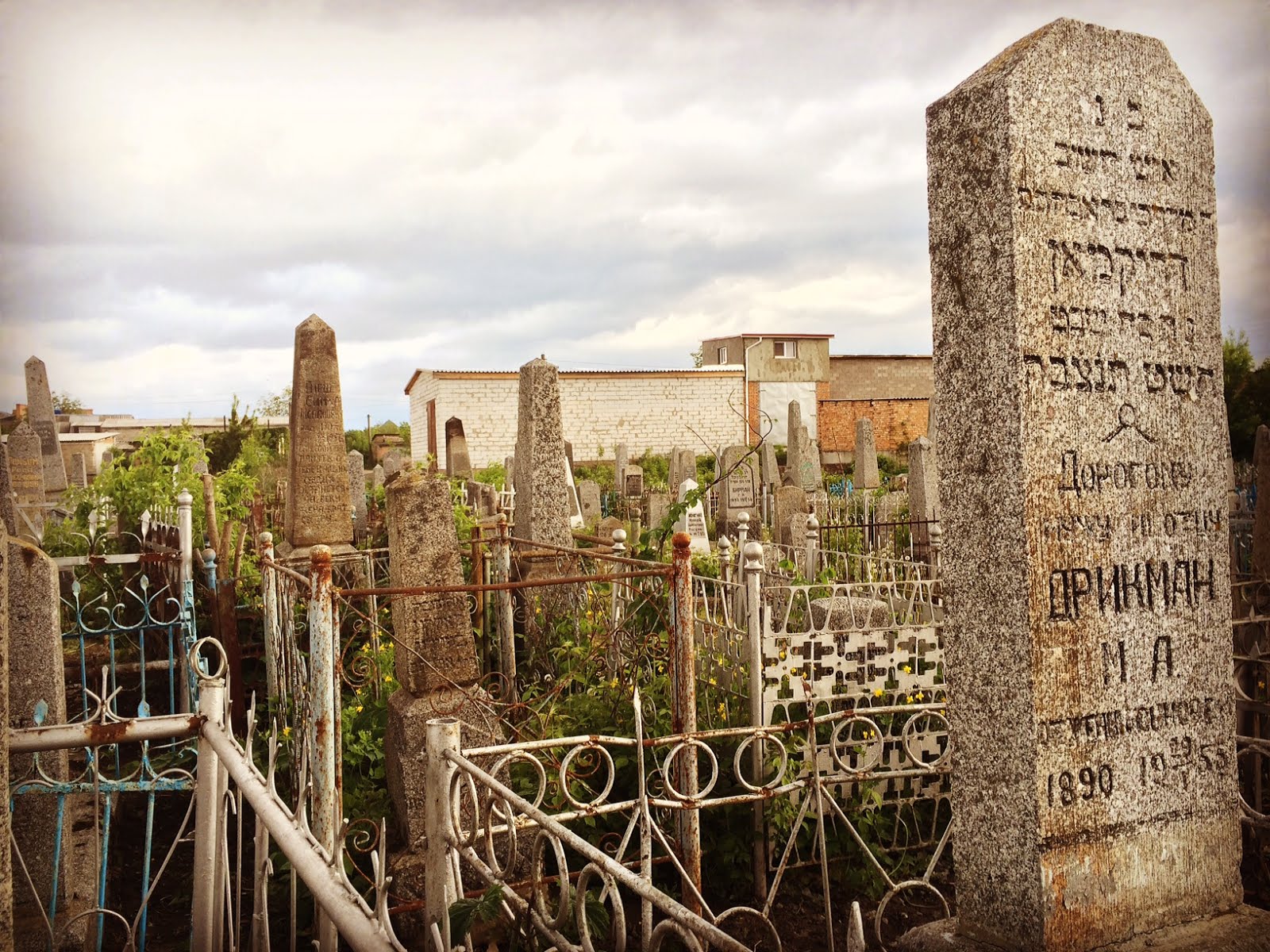
The Jewish cemetery compares to the size of Paris' Père Lachaise. Dozens of acres. The stones are shaped like the ghost in Studio Ghibli's Spirited Away, long humps with a cloak-like front and a flat face on which to carve the Hebrew script. The site goes on and on. I've never seen anything like it. There are paths between the groupings of stones, where men walk home from work and women tend their chicken flocks. The ghost stones have been heaved by frost and perhaps mortar shells until they lie every which way. The script on most is indecipherable. Some, in larger plots, have obviously been tended, the writing blacked in, the letters refreshed. To look through all of them would take days.
I crept through, hoping for a Nuchims carved on a stone or two. Instead I found a giant passel of Israelis. "There are sometimes two busloads a day," Sasha, a local Jew, one of only 300 left today in the town, told me. He lost his restaurant job recently and I met him selling images of the crypt of Rabbi Levi Yitzchok, which lies in the centre of the cemetery and was the destination point for the sidelocked and kerchief'd Israelis. I asked him if this was where the 30,000 were buried and he said no, but that he would take me if I could wait five minutes. I could. I stepped into the hut that held the Rabbi's remains, feeling, as always, totally out of place, apologetic, and as if everyone could see that I've been to shul perhaps five times in my life, and have no idea how to take Kiddish. The books on the shelves were all in Hebrew. Women were taking Iphone photos of one another kissing the covering over the grave. Others were praying. The married ones wore head scarves. I recognized my face, my family's faces. But we didn't speak, aside from one older woman who told me this was a pilgrimage. I was glad I had missed the actual ceremony. Outside, three younger men begged for money from the Israelis. The vocal one, with blond sidelocks down to his chest and bare feet shoved into what looked like hotel slippers, told me he was from New York City, but lived here. I refrained from asking him how much his trust fund gave him every month.
Sasha drove me to the ravine where the 30,000 were shot in 1941 (12,000 in one day) and pushed into pits, where they died of suffocation or drowned in blood. The ravine was chlorophyl green with alder and sapling maple. Sasha's English wasn't good enough to answer when I asked whether the bodies were still there. Then he drove me to the synagogue, for another dose of instant discomfort, and disappeared into a reading group, showing me the women's room down below before he sat with a group of men. The shul looked like an old school. There were no identifying marks on the outside, though he said he has encountered not a single incident of anti-semitism since he arrived from Kyiv 17 years ago.
I found a taxi driver who looked so Russian he could have been mistaken for my friend Max in Mexico, all long, delicate fingers and chestnut skin. He took me to a pool hall, then a restaurant, and waited until he knew I could eat there. He pulled the bills from my wallet carefully and continued chattering in Russian until I felt like I could understand him just by his tone. I sat and drank tequila and smoked and ate the toppings off of a pizza until I was paralyzed enough, and then I walked back to the hotel with a giant beer.
This is the far side of our journey as Europeans to North America. To be here is to rest in the abandoned beginning of the story, with the unknown relatives, and the secular feeling that will not go away, and the incredulousness that anyone -- anyone -- could still kiss a shrine and not feel the need to laugh self-consciously at the absurdity and destructiveness of religion. My incredulity wears itself in silence and a lack of knowledge about any rituals except the arguing around the Passover table that I covet, and can't get enough of, and which have nothing to do, whatsoever, with belief in anything other than love and long meals and intelligence and ferocity. But these, too, are traditions of Judaism. So I take the one part and leave the other, not just in a gesture of eternal questioning, but one of something akin to aghast disbelief. My grandmother became a believer in Unions and Peace Marches and striking workers and passed her "a little to the left of Trotsky" views on to my father, and then on to his daughters. Meanwhile there's a city's worth of bones lying in the centre of town that bear witness, along with thousands of visitors, while the paths through their midst are worn bare. I'm sitting in this hotel which cost 16 dollars for a two-room suite. The Ukranian woman who gave it to me, like pretty much every other Ukrainian woman and man I've met on this trip, looked at me with affection and chagrin, and encouraged my six words of Russian, and took care that at least the body could be alright.
Friday, May 6, 2016
(Re)turn to Kiev
A year ago I wrote a proposal for this tiny grant. I wanted to revisit the places my family was from -- parts of Eastern Europe that only my father had visited, and only during the cold war, when he danced with his first two daughters and the Russian solidiers in the squares behind the iron curtain. He asked for directions to Vilnius, his father's homeland, and no one knew what he was saying, and so he didn't go. He never made it as far south as his mother's homeland, where I am now. Former Russia, Jews that consider themselves Russia but lived in what is now Ukraine.
 I got one part of the grant: this one -- to explore Lithuania, Poland and Ukraine. To find any traces. The other, a trip down to LA with my father, to explore the valley where his father's gas station was, to name the streets that used to be fields, to experience the heat he hates, that part wasn't funded. And he is 80 now, so there was that sense of untenability, I expect, with the granters, and of urgency on my part.
Letters written between my great uncles and cousins have opened up lines of communication that were quiet before this trip came into being. They are talking to one another about my institutionalized great uncle, about the artists in the family, about the long histories of love and reserve and rancour that stretch through the generations, and that are being, I hope, healed somewhat by my questions. My questions: What should I look for? Who do you know there? What traces remain? Who was our family? Why did they leave? Who remained? What happened to them?
In Kiev, there are archives. In Berdychiv, there was my grandmother's family. And there are the statistics: 90% killed in the second world war; 40,000 in the Pograms at the turn of the century. The immigrants to Buenos Aires and Ellis Island. Those who immigrated never talked about the old country.
But what is the old country? Tonight I wandered around Podil, the former Jewish ghetto of Kiev. I stopped for a beer at a corner by a metro station. The man wouldn't take Euros. Everyone seemed so white. I was looking for signs that they were violent, or mean. I admit that. I found none. It is a beautiful city made of some of the most beautiful young women I've ever seen, and young men who seem intent on making them happy. Soviet style block-ish houses sidle up against 18th century apartments. There is graffiti everywhere. Abandoned buildings abut new constructions. The cobbles are shaped blocks. When a rain storm passed over, people huddled under the awnings, smoking, and didn't seem at all perturbed.
I had received a ride into the city from a doctor who practices holistic integrative medicine, and travels the world consulting. He is from Siberia and has lived in Kiev for 37 years. He got his assistant to drive me right to my hotel door, after bringing us to his clinic. He gave me his card and told me to call if I have trouble, and to not miss seeing the New Botanical Gardens, where all the lilacs in the world are currently in bloom.
After the rain, I walked back toward the hotel, and then kept going. I circled the rural hill where giant St. Andrew's Church sits on a promontory. I turned a corner. Buena Vista Bar. "Hablamos Español" said the sign. I hadn't spoken to anyone in a meaningful way in two days. I scored a seat with a view of the band and the entry, and for two hours drank tequila and ate tacos and watched group after group literally dance their way down the stairs into the underground bar. Cuban waiters, who when I looked quizzical, said, "We all end up somewhere." The band was fantastic. The lead singer came up to talk to me on the break. I told him why I was here. He pulled out a star of David from a chain under his shirt. "Are there any other bars in Kiev that speak Spanish?" I asked. "I doubt it," he smiled. Beautiful woman after beautiful woman sashayed on the dance floor. The men who knew how lead them in salsa and cumbia, and knew enough to step back during the cha-cha. They were young, and thin, and laughing, and the place was like a living room where everyone knew one another.
The past perhaps lives on stronger in those who have left. In this city, there's a set of cheekbone and jawline that I admit makes me feel skittish. But I've found little but laughter and instantaneous generosity. Men carrying boiled eggs and meat around in plastic bags for the after-drink snack. Dried fish in stacks on the bar. American music on the stereo. The waitress with tattoos up her neck singing, "beep beep!" as she passes, to the dancers.
The stones of the buildings may not have moved on. The earth in the greening fields around the city as we flew in. The cobbles upturned and kicked by a man off the side of the street. The occasional fracas, like the burning bottle thrown through Podil's synagogue two years ago. But there's this pull in two directions. I'm in the river of it, flowing both ways.

Letters written between my great uncles and cousins have opened up lines of communication that were quiet before this trip came into being. They are talking to one another about my institutionalized great uncle, about the artists in the family, about the long histories of love and reserve and rancour that stretch through the generations, and that are being, I hope, healed somewhat by my questions. My questions: What should I look for? Who do you know there? What traces remain? Who was our family? Why did they leave? Who remained? What happened to them?
In Kiev, there are archives. In Berdychiv, there was my grandmother's family. And there are the statistics: 90% killed in the second world war; 40,000 in the Pograms at the turn of the century. The immigrants to Buenos Aires and Ellis Island. Those who immigrated never talked about the old country.
But what is the old country? Tonight I wandered around Podil, the former Jewish ghetto of Kiev. I stopped for a beer at a corner by a metro station. The man wouldn't take Euros. Everyone seemed so white. I was looking for signs that they were violent, or mean. I admit that. I found none. It is a beautiful city made of some of the most beautiful young women I've ever seen, and young men who seem intent on making them happy. Soviet style block-ish houses sidle up against 18th century apartments. There is graffiti everywhere. Abandoned buildings abut new constructions. The cobbles are shaped blocks. When a rain storm passed over, people huddled under the awnings, smoking, and didn't seem at all perturbed.
I had received a ride into the city from a doctor who practices holistic integrative medicine, and travels the world consulting. He is from Siberia and has lived in Kiev for 37 years. He got his assistant to drive me right to my hotel door, after bringing us to his clinic. He gave me his card and told me to call if I have trouble, and to not miss seeing the New Botanical Gardens, where all the lilacs in the world are currently in bloom.
After the rain, I walked back toward the hotel, and then kept going. I circled the rural hill where giant St. Andrew's Church sits on a promontory. I turned a corner. Buena Vista Bar. "Hablamos Español" said the sign. I hadn't spoken to anyone in a meaningful way in two days. I scored a seat with a view of the band and the entry, and for two hours drank tequila and ate tacos and watched group after group literally dance their way down the stairs into the underground bar. Cuban waiters, who when I looked quizzical, said, "We all end up somewhere." The band was fantastic. The lead singer came up to talk to me on the break. I told him why I was here. He pulled out a star of David from a chain under his shirt. "Are there any other bars in Kiev that speak Spanish?" I asked. "I doubt it," he smiled. Beautiful woman after beautiful woman sashayed on the dance floor. The men who knew how lead them in salsa and cumbia, and knew enough to step back during the cha-cha. They were young, and thin, and laughing, and the place was like a living room where everyone knew one another.
The past perhaps lives on stronger in those who have left. In this city, there's a set of cheekbone and jawline that I admit makes me feel skittish. But I've found little but laughter and instantaneous generosity. Men carrying boiled eggs and meat around in plastic bags for the after-drink snack. Dried fish in stacks on the bar. American music on the stereo. The waitress with tattoos up her neck singing, "beep beep!" as she passes, to the dancers.
The stones of the buildings may not have moved on. The earth in the greening fields around the city as we flew in. The cobbles upturned and kicked by a man off the side of the street. The occasional fracas, like the burning bottle thrown through Podil's synagogue two years ago. But there's this pull in two directions. I'm in the river of it, flowing both ways.
Thursday, May 5, 2016
Three hours in Istanbul
 Lovely Turkish Airlines. On my way to Kiev to find anything remaining about my paternal grandparents, I missed my connection. Notwithstanding the complaining Israelis in line behind me (have I ever met an Israeli traveler that wasn't complaining about something?), their whisking of more than 80 travellers who had missed their connections or had long layover times to a local hotel near the airport was a treat I wasn't expecting.
I should be writing from Kiev tonight, but instead I've just returned from the best Baklava in my life and rose-scented (covered in rose petals) Turkish delight, riding the very last trolley home in cars and cars full of polite, beautiful Turkish men to the next to last stop, after spending the evening roaming the old city and the outside perimeter of the Hagia Sophia and the Sultan Ahmed Mosque. The other travellers I came to the hotel with chose to stay and dine, and then fall asleep for the few brief hours before the 2:30am wake up call to go back to the airport. But why waste time in a hotel when you could be walking the cobbles of Istanbul, standing at the edge of the Bosphorus that divides Europe from Asia, stepping on the worn marble stairs at the entrance to the mosque? No sleeping for me.
Highlights:
The cup of fresh squeezed pomegranate juice, street-side. He waited until my cup was half empty and then filled it again.
A quarter cup of Saffron given to me by a Syrian; it is from Iran, he told me. We are in the cradle of the world.
The three piece drum and horn and clarinet-type instrument band that played to patio patrons of a local bar. Beautiful, Persian melody. A thin man sitting at a table rose and began dancing to the song. He kicked his heels behind him like a rooster, rolling his shoulders and throwing his head high. Another woman joined him. When I gave the musician 5 lira, he wiped it across the bottom of his chin and smiled. Too much? Too little? Who knows.
The expansive gardens and chestnut sellers under the trees in the plazas between the mosque and the Sophia. The filigree wrought iron fences, the mosaics on the walls, the arching courtyards as the last call of the Muezzin sounded.
The peaceful feel of the people. The laughter. Late at night the city is all tungsten light and balconies and a dozen languages, as people eat fish and sweets and goat and tahine and shining vegetables. I had two Raki with a side of ice, a liquorice liquor wonder that turns white when water is added.
And now I have a Turkish visa, and so could return easily, if my research ends when I think it will.
What a delightful way to start the trip. One need only embrace the unexpectedness that comes and the rest is honey and roses and giant moustaches.
Friday, December 25, 2015
Cojetes y Fuegos
I've been here before.
Last Christmas eve, I was peering down from the third floor of a house on the street, Calle de Cuba, as we've renamed it - for all the mechanics disassembling cars, the carpenters sanding boards, the babies crawling on the cobblestones that occur on this small block. I've lived here for a year. When I'm not living here, I'm still living here in some way.
This Christmas, I know the drill. I know the food won't start until midnight. I know the preparation of tables and fires on the cobblestones won't start until 11. I knew the piñatas won't start until 2am. I go to my friends' house to wait it out, snacking on beans before I leave and then eating a small meal at their house - jamon and sweet potato and tequila. This is first dinner. Their 25 year old guest, Carlos, the bartender at a local place, wants to go to Canada. He wants to see snow. He doesn't want to inherit his father's bar. Anywhere but here, he says, except to visit.
Bob, the husband of Sandy, and I amble down to Cuba and sit on white picnic chairs. My best friend Max is nowhere to be seen. We chat with the owner of the fire, built on the cobblestones. The fires occasionally cause the stones to crack and explode, sending shards to either side of the street. Above hangs a rope and a hook, meant for the piñatas. It is the first time I have seen all of the street since early September. Cookie-giving commences. Much kissing. Ana has saved me a scarf she says was 'Maleea.' I put it on. I am handed a styrofoam plate by the neighbours of Magda and Lupe. Turkey, stuffing, mashed potatoes, salsa picante, corn, rice. Second dinner. I gulp it down. I kiss the chef.
I am expected up the street again, where Ana and Fernando are cooking. My best friend Max shows up, unable to stand, he is so drunk. He doesn't want food. He's a scarecrow in a sweater I've brought him, already scuffed from his falls. We sit at Ana's table. Third dinner: turkey, rice, mashed potatoes, gravy, corn, salsa, butter-grilled bread. It soaks up the tequila I've been drinking all evening. I forget the drunkenness, until "vete a la verga" escapes his mouth, because you don't talk to drunks when they can't form a sentence, when everyone else in the family averts their eyes and tucks their mouths and makes a gentle joke of something unrelated, and his brother says to me, his eyes kind, "he was fine two hours ago."
I advance to the piñata. We are there to watch, but the boy hands me the stick, saying, "girls do this too." And adults, apparently. "Arriba!" they yell. "Abajo!" I swing. I make contact. It is like a line of a poem zinging out of the wilderness. It has nothing to do with me. When the burro explodes, shattering greenware red clay over the stones, I am there picking out the tamarindo candies. Max operates the rope, until someone gently relieves him of it.
"Vete a la chingada," I say, as we part. And "nos vemos mañana," because I still love him, and alcohol for an almost purely indigenous carpenter is a fuck-up that has 300 years or more of colonial guilt attached. I walk home down the small cobblestone street I have walked 100 times before. A girl swings out of the next block in front of me. She wears a black shirt with a zipper up the back, a short, beautiful skirt. She looks back. She smiles. "I have gas," she says, hearing me insult my friend and hearing him call after me as I stalk away. She pulls out a canister. I smile. "Not at this point," I say. She must be visiting. She is too beautiful for words. She has a white dog that she walks perfectly while smoking a cigarette.
Now it is 4am. The neighbours in my friend Jeanne's barrio, where I am staying, break out another load of fireworks. The children scramble for the candy. Neighbours serve food to whoever passes. White plastic chairs shift and lodge into the dirt spaces between stones. Huapango, cumbia, ranchero, banda. A woman's raucous laughter. The courtly men. The lightest of touches on the perfectly imperfect world.
Last Christmas eve, I was peering down from the third floor of a house on the street, Calle de Cuba, as we've renamed it - for all the mechanics disassembling cars, the carpenters sanding boards, the babies crawling on the cobblestones that occur on this small block. I've lived here for a year. When I'm not living here, I'm still living here in some way.
This Christmas, I know the drill. I know the food won't start until midnight. I know the preparation of tables and fires on the cobblestones won't start until 11. I knew the piñatas won't start until 2am. I go to my friends' house to wait it out, snacking on beans before I leave and then eating a small meal at their house - jamon and sweet potato and tequila. This is first dinner. Their 25 year old guest, Carlos, the bartender at a local place, wants to go to Canada. He wants to see snow. He doesn't want to inherit his father's bar. Anywhere but here, he says, except to visit.
Bob, the husband of Sandy, and I amble down to Cuba and sit on white picnic chairs. My best friend Max is nowhere to be seen. We chat with the owner of the fire, built on the cobblestones. The fires occasionally cause the stones to crack and explode, sending shards to either side of the street. Above hangs a rope and a hook, meant for the piñatas. It is the first time I have seen all of the street since early September. Cookie-giving commences. Much kissing. Ana has saved me a scarf she says was 'Maleea.' I put it on. I am handed a styrofoam plate by the neighbours of Magda and Lupe. Turkey, stuffing, mashed potatoes, salsa picante, corn, rice. Second dinner. I gulp it down. I kiss the chef.
I am expected up the street again, where Ana and Fernando are cooking. My best friend Max shows up, unable to stand, he is so drunk. He doesn't want food. He's a scarecrow in a sweater I've brought him, already scuffed from his falls. We sit at Ana's table. Third dinner: turkey, rice, mashed potatoes, gravy, corn, salsa, butter-grilled bread. It soaks up the tequila I've been drinking all evening. I forget the drunkenness, until "vete a la verga" escapes his mouth, because you don't talk to drunks when they can't form a sentence, when everyone else in the family averts their eyes and tucks their mouths and makes a gentle joke of something unrelated, and his brother says to me, his eyes kind, "he was fine two hours ago."
I advance to the piñata. We are there to watch, but the boy hands me the stick, saying, "girls do this too." And adults, apparently. "Arriba!" they yell. "Abajo!" I swing. I make contact. It is like a line of a poem zinging out of the wilderness. It has nothing to do with me. When the burro explodes, shattering greenware red clay over the stones, I am there picking out the tamarindo candies. Max operates the rope, until someone gently relieves him of it.
"Vete a la chingada," I say, as we part. And "nos vemos mañana," because I still love him, and alcohol for an almost purely indigenous carpenter is a fuck-up that has 300 years or more of colonial guilt attached. I walk home down the small cobblestone street I have walked 100 times before. A girl swings out of the next block in front of me. She wears a black shirt with a zipper up the back, a short, beautiful skirt. She looks back. She smiles. "I have gas," she says, hearing me insult my friend and hearing him call after me as I stalk away. She pulls out a canister. I smile. "Not at this point," I say. She must be visiting. She is too beautiful for words. She has a white dog that she walks perfectly while smoking a cigarette.
Now it is 4am. The neighbours in my friend Jeanne's barrio, where I am staying, break out another load of fireworks. The children scramble for the candy. Neighbours serve food to whoever passes. White plastic chairs shift and lodge into the dirt spaces between stones. Huapango, cumbia, ranchero, banda. A woman's raucous laughter. The courtly men. The lightest of touches on the perfectly imperfect world.
Saturday, September 5, 2015

With four days left here now, I´m down to tricking my brain. You have a whole long weekend, I say. You have almost a week. Think of how many vacations you've taken that were only four days that seemed to last forever. For now I am truly, for this last week, on vacation. Today, a primo's birthday party. Tomorrow, a giant carne asada with the main family from this street, including the tias locas, at least four brothers, their wives and their childrens' new baby. Monday, a smaller affair down at the water´s edge, under the tree el Dictador calls his segunda arbol. He´s going to set up a hammock and some coals. All my favourite people will be there.
Sometimes a life changes, takes a 180 turn. This is the longest continuous period of time I've spent in this country since I was 20. My only thought now is that this is a drop in the bucket, compared to the time I want to (and will) spend here in the future.
Tuesday, August 25, 2015
Mexico: Made for the Food Addict and the Shut-In
"I'm hungry," I thought to myself in Mexico, never.
 Last Sunday, some friends and I went to eat comida casera, home made dishes complete with made-to-order corn tortillas, slap-slapped to round perfection by the side of the road by three generations of women and dropped into the basket on your table every three minutes or so in San Juan Cosalá. You use a half of the tortilla to scoop up little pockets of beans, tomatillo salsa, pieces of a chile relleno and bistek a la tomate, and deftly (if possible) deposit the whole thing in your mouth. The men use their tortillas as napkins. Each tortilla, placed on the comal heated by small pieces of mequite, goes down, gets flipped, blows up like a pufferfish, and gets tossed in your basket. You eat 10-15 during a meal. You're really, really not hungry when you leave.
You're even less hungry when you stop at Pedro's on the way back, order a half kilo of carnitas (shaved pig meat that's been deep fried in giant chunks in vats of lard) and a piece of flan, an egg and cream cake with a topping of burnt sugar. The carnitas arrive with six different salsas, all hot. You begin to leak tears and sweat. The struggle to finish begins to seem like a kind of Iron Man of eating.
By the time you end up at your destination, a weekly family gathering of 54 immediate family members, it's just before comida, about 4pm. You can hear the taco meat sizzling before you even get through the door. Your stomach feels like a pufferfish's. The grandparents, their nine children, their nine children's spouses, their nine children's 31 children and their 3 grandchildren all greet you with cheers. "Sit down!" they say. "How many tacos do you want?" A rigorous game of poker continues. The grandparents clean house. The tequila arrives in a pop bottle from someone's back yard agave plantation. The kids run around screaming. A storm on the opposite side of the lake sends wind that knocks the flip flops and kids' socks across the lawn like confetti. There are 1940's Mexican movies playing on the giant screen TV. The vat of meat is the size of a beer fridge. Arm waving doesn't work; you can't refuse what they offer. "Only three tacos?" they ask in shock. "Are you sick?"
Later, when the various brothers and sisters are dragging one another across the lawn, one by one, and throwing one another in the pool, you think that when they finally turn on you, like a pack of happy wolves, and throw you in, fully clothed, you might actually sink. That thought is proven a reality at about 8pm. When you struggle to the surface, a little girl is staring at you, a green inflated tube sits around her waist. You look down. You have the same inflated tube around your waist. Except yours isn't made of air. "How old are you?" she asks. "One hundred and fifty-two," you answer. You're not sure if you mean years or pounds.
Of course, if you stay home, it's no better. Today, from my front door, I've been offered mangos, papayas, pinapples, apples, guavas, flour tortillas, corn tortillas, elotes, cacahuates, tamales, water, pop, tortas and cuts from a pig. If I wanted to, I could stay here all day and everything I need, including the knife-sharpener with his high-low whistle, would arrive pretty much as soon as I thought of needing it. Last week, someone offered me a clock and a hallway chandelier. The week before, electrical tape and a load of firewood.
Some of them ring the bell, but mostly they just scream or play a recording of themselves screaming as they come down the street. "Llévate para mangos, mangos, mangos, llévate, piñas!" "Eloooootes, cacahuaaaaaaates," croons the sombrero-wearing, bicycle-riding elote and cacahuate seller, in a baritone that sends thrills of pleasure down my spine. I take the two floors of stairs two at a time for the flan seller. Sometimes I miss him and a chill of almost hunger pangs me. It's such an unfamiliar feeling that I wonder if I might be ill. Then the ice cream bicycle turns the corner.
 Last Sunday, some friends and I went to eat comida casera, home made dishes complete with made-to-order corn tortillas, slap-slapped to round perfection by the side of the road by three generations of women and dropped into the basket on your table every three minutes or so in San Juan Cosalá. You use a half of the tortilla to scoop up little pockets of beans, tomatillo salsa, pieces of a chile relleno and bistek a la tomate, and deftly (if possible) deposit the whole thing in your mouth. The men use their tortillas as napkins. Each tortilla, placed on the comal heated by small pieces of mequite, goes down, gets flipped, blows up like a pufferfish, and gets tossed in your basket. You eat 10-15 during a meal. You're really, really not hungry when you leave.
 You're even less hungry when you stop at Pedro's on the way back, order a half kilo of carnitas (shaved pig meat that's been deep fried in giant chunks in vats of lard) and a piece of flan, an egg and cream cake with a topping of burnt sugar. The carnitas arrive with six different salsas, all hot. You begin to leak tears and sweat. The struggle to finish begins to seem like a kind of Iron Man of eating.
By the time you end up at your destination, a weekly family gathering of 54 immediate family members, it's just before comida, about 4pm. You can hear the taco meat sizzling before you even get through the door. Your stomach feels like a pufferfish's. The grandparents, their nine children, their nine children's spouses, their nine children's 31 children and their 3 grandchildren all greet you with cheers. "Sit down!" they say. "How many tacos do you want?" A rigorous game of poker continues. The grandparents clean house. The tequila arrives in a pop bottle from someone's back yard agave plantation. The kids run around screaming. A storm on the opposite side of the lake sends wind that knocks the flip flops and kids' socks across the lawn like confetti. There are 1940's Mexican movies playing on the giant screen TV. The vat of meat is the size of a beer fridge. Arm waving doesn't work; you can't refuse what they offer. "Only three tacos?" they ask in shock. "Are you sick?"
Later, when the various brothers and sisters are dragging one another across the lawn, one by one, and throwing one another in the pool, you think that when they finally turn on you, like a pack of happy wolves, and throw you in, fully clothed, you might actually sink. That thought is proven a reality at about 8pm. When you struggle to the surface, a little girl is staring at you, a green inflated tube sits around her waist. You look down. You have the same inflated tube around your waist. Except yours isn't made of air. "How old are you?" she asks. "One hundred and fifty-two," you answer. You're not sure if you mean years or pounds.
Of course, if you stay home, it's no better. Today, from my front door, I've been offered mangos, papayas, pinapples, apples, guavas, flour tortillas, corn tortillas, elotes, cacahuates, tamales, water, pop, tortas and cuts from a pig. If I wanted to, I could stay here all day and everything I need, including the knife-sharpener with his high-low whistle, would arrive pretty much as soon as I thought of needing it. Last week, someone offered me a clock and a hallway chandelier. The week before, electrical tape and a load of firewood.
Some of them ring the bell, but mostly they just scream or play a recording of themselves screaming as they come down the street. "Llévate para mangos, mangos, mangos, llévate, piñas!" "Eloooootes, cacahuaaaaaaates," croons the sombrero-wearing, bicycle-riding elote and cacahuate seller, in a baritone that sends thrills of pleasure down my spine. I take the two floors of stairs two at a time for the flan seller. Sometimes I miss him and a chill of almost hunger pangs me. It's such an unfamiliar feeling that I wonder if I might be ill. Then the ice cream bicycle turns the corner.
Tuesday, August 4, 2015
Axixic Life
"México, me dices cosas bonitas, y otras cosas no tan bonitas."
 Yesterday evening, while a dog covered in confetti nosed up to me in the plaza while varying numbers of friends and I were listening to the live, free Cumbia band begin, at about 10:30pm, for all the kids and adults milling around playing with coloured, hollow eggs (which contain the confetti), eating tacos, promenading around the square, drinking tequila or cerveza, dancing or gossiping, I was trying to think how I would describe this life to people not living in Mexico. Like how you know when you leave the house on a Sunday, everyone’s (and my) day off, you can’t be sure where you’ll end up. Comida casera by the side of the road with four generations of women tortillerando turns into a visit to Kim’s house, who takes you to her husband’s daughter’s husband’s family for a second comida, at which point you feel like you may indeed be pregnant with taquitos, after eating so many tortillas, and the discussions around the table--while the kids are running around and following the grandmother back and forth to the kitchen – range from Franco to Obama to pardon rules for Mexicans trying to enter the US after being wrongfully convicted of crimes by the US justice system to the paintings that Jeanne has made over the last 20 years, many of them depicting the Mexican revolution in colours that defy your ability to categorize them. Then, someone she knows stops by the side of the road and gives you a ride from San Juan Cosalá, even though he’s going in the opposite direction, and you end up with the confetti dog at your feet, laughing about a dozen things at the same time, and it’s midnight and 22 degrees and the pool hall around the corner is waiting, as is the taco stand, and the lake at night, and the poem in your book not yet translated into the digital world, and all your readings for the PhD that seem to be leading toward a synthesis of body and ground and lyric and world.
The night after I wrote this first paragraph, however, the country gave me some gentle instruction on the art of not living in a dream world of pleasure without recognizing the hardship also in evidence on a daily basis. Standing in the square that same night that I described, my friend Max, out of work for the third time that spring, saw his three daughters pass by, whom he had recently relinquished to an American/Guadalajaran couple so that they would have a chance at a better life. Broke and heartbroken, the next night he went on an overnight drunk at our friend’s house and told me he was going to accept an offer to join the Sinaloa cartel. Three men had taken him to dinners in Guadalajara earlier this year. They paid for everything. They promised him $8000 pesos a week. Sinaloa is currently trying to protect its holdings as the Nueva Generacion Jalisco, Mexico’s newest cartel, tries to enlarge its territory. They prey on vulnerable members of a community. If he took the offer (he didn't), he would have likely received closer to $100 pesos a week to act as a halcon, or village lookout, or would have been used as a mule, ferrying cocaine, marijuana and meth over the border in a car.
In our friends’ inner patio he swayed along with the guitar players, singing off key and trying to fill everyone’s glasses with more tequila, an act badly seen in more educated circles. We were driven home in courteous silence. A request arrived through a friend the next week that he not attend their music events again. In the street that night, he fingered his cell phone, swearing that I’d never see him again if he made the call. He had less than 50 pesos to his name. I let him in, gave him a tranquilizer – the first he’d ever taken – and left him to sleep. The next morning he was a shell, but he walked out into the sun and found work building a kitchen for the man who had ferried us home the night before. Poverty here is immediate, and immediately reversible, if one knows the right people. Most of my friends live within days of destitution. In the ten years Max spent working in the United States as an ilegal he sent every penny home to his parents. He arrived home with less than $500 to his name.
Alcoholism is rampant. The week before I arrived to Ajijic in May, Fernando, Max’s brother, didn’t stop drinking on a Saturday night. He stumbled and cajoled in the street, asking his wife Ana for money to buy meth, which has found its way to this town through the cartels. The police arrived after Ana called them. Eventually, they took him away and he was gone for nearly two months, staying in a government centre for drug and alcohol abuse with its own psychiatrist, three outdoor toilets for 90 men and thirty bunks to a room with no fan. Don’t bring me money, he told us, his eyes wet, when we visited him in mid May. But I’d like some face cream. We were eating the roadside chicken we'd brought him, using tortillas as utensils, sitting on a fiberglass-roofed patio as a thunderstorm let loose around us. When the lightning and thunder were simultaneous, the men in the centre cheered and whistled from the doors of their bunkrooms. On the way home, Ana, Max, Angel and his wife Isa and I sat five to the cab up the dirt road to Santa Cruz, and used our legs to brace when we went over the topes so we wouldn’t crush the laps of the boys. We stopped at Suriana and bought a crib for Angel and Isa’s baby, who was born in July. The parents are 18; the crib is a quarter the size of their room.
It may be incidents with alcohol like these that spur the racism I’ve found in this town, by the white visitors (whether they are permanent residents or simply snowbirds) toward the Mexican population. Or it may simply be the differences in culture and way of life, or it may be the poverty. Or it may simply be the entitlement I feel radiating from so many foreigners, even when they profess to be open-minded. One couple from Canada I contacted told me I was welcome to stay as long as I didn’t let any of the local neighbours or their children enter the property. Their double house is the largest on the block. I was delighted to find out that when the Canadians leave for their six months in the north, the property’s pool is renamed the Community Pool.
 Still, despite so many foreigners living in such close proximity to locals, the separation of gardener or housecleaner from friend seems mostly absolute. One American woman who lives with her husband in a spacious oasis of garden and ranch-style house in West Ajijic, holds parties for the locals, but only outside. A bathroom is available, as is the kitchen, but the rest of the house is never entered by people not of her race. Everyone, it seems, knows their place. Through it all, the Mexicans maintain a grace and equanimity I doubt Americans or Canadians could manage for more than five minutes. Working for four dollars an hour cleaning miradors and pools, they learn enough English to make their employers happy, and then go home to two pantry-sized rooms, shared sometimes by multiple families.
And so I try to navigate the unspoken rules and regulations of behaviour and relationships, and sometimes I fail and sometimes it goes well. The only thing I know for sure here is that no culture is a Disneyland of kindness and perfection. But neither is it acceptable for my race to arrive in another country, look around and say (true story), “this place is perfect, except for the Mexicans.”

The night after I wrote this first paragraph, however, the country gave me some gentle instruction on the art of not living in a dream world of pleasure without recognizing the hardship also in evidence on a daily basis. Standing in the square that same night that I described, my friend Max, out of work for the third time that spring, saw his three daughters pass by, whom he had recently relinquished to an American/Guadalajaran couple so that they would have a chance at a better life. Broke and heartbroken, the next night he went on an overnight drunk at our friend’s house and told me he was going to accept an offer to join the Sinaloa cartel. Three men had taken him to dinners in Guadalajara earlier this year. They paid for everything. They promised him $8000 pesos a week. Sinaloa is currently trying to protect its holdings as the Nueva Generacion Jalisco, Mexico’s newest cartel, tries to enlarge its territory. They prey on vulnerable members of a community. If he took the offer (he didn't), he would have likely received closer to $100 pesos a week to act as a halcon, or village lookout, or would have been used as a mule, ferrying cocaine, marijuana and meth over the border in a car.
In our friends’ inner patio he swayed along with the guitar players, singing off key and trying to fill everyone’s glasses with more tequila, an act badly seen in more educated circles. We were driven home in courteous silence. A request arrived through a friend the next week that he not attend their music events again. In the street that night, he fingered his cell phone, swearing that I’d never see him again if he made the call. He had less than 50 pesos to his name. I let him in, gave him a tranquilizer – the first he’d ever taken – and left him to sleep. The next morning he was a shell, but he walked out into the sun and found work building a kitchen for the man who had ferried us home the night before. Poverty here is immediate, and immediately reversible, if one knows the right people. Most of my friends live within days of destitution. In the ten years Max spent working in the United States as an ilegal he sent every penny home to his parents. He arrived home with less than $500 to his name.
Alcoholism is rampant. The week before I arrived to Ajijic in May, Fernando, Max’s brother, didn’t stop drinking on a Saturday night. He stumbled and cajoled in the street, asking his wife Ana for money to buy meth, which has found its way to this town through the cartels. The police arrived after Ana called them. Eventually, they took him away and he was gone for nearly two months, staying in a government centre for drug and alcohol abuse with its own psychiatrist, three outdoor toilets for 90 men and thirty bunks to a room with no fan. Don’t bring me money, he told us, his eyes wet, when we visited him in mid May. But I’d like some face cream. We were eating the roadside chicken we'd brought him, using tortillas as utensils, sitting on a fiberglass-roofed patio as a thunderstorm let loose around us. When the lightning and thunder were simultaneous, the men in the centre cheered and whistled from the doors of their bunkrooms. On the way home, Ana, Max, Angel and his wife Isa and I sat five to the cab up the dirt road to Santa Cruz, and used our legs to brace when we went over the topes so we wouldn’t crush the laps of the boys. We stopped at Suriana and bought a crib for Angel and Isa’s baby, who was born in July. The parents are 18; the crib is a quarter the size of their room.
It may be incidents with alcohol like these that spur the racism I’ve found in this town, by the white visitors (whether they are permanent residents or simply snowbirds) toward the Mexican population. Or it may simply be the differences in culture and way of life, or it may be the poverty. Or it may simply be the entitlement I feel radiating from so many foreigners, even when they profess to be open-minded. One couple from Canada I contacted told me I was welcome to stay as long as I didn’t let any of the local neighbours or their children enter the property. Their double house is the largest on the block. I was delighted to find out that when the Canadians leave for their six months in the north, the property’s pool is renamed the Community Pool.

And so I try to navigate the unspoken rules and regulations of behaviour and relationships, and sometimes I fail and sometimes it goes well. The only thing I know for sure here is that no culture is a Disneyland of kindness and perfection. But neither is it acceptable for my race to arrive in another country, look around and say (true story), “this place is perfect, except for the Mexicans.”
Subscribe to:
Posts (Atom)